Guides/Article
Museum Artwork Caption Examples (Painting, Photo, Sculpture)
8 min read · Updated September 11, 2026
Looking at real museum artwork caption examples is the fastest way to learn the format. Once you see how paintings, photographs, and sculpture are labeled, you can copy the pattern for your own portfolio, exhibition, or catalog.
Below are short and extended examples you can adapt, plus notes on what changes by medium. If you want the full field-by-field guide first, read How to Write a Museum-Style Artwork Caption.
The pattern behind every example
Almost every museum label follows the same sequence: artist, title, date, medium, dimensions, then credit line. Examples look polished because the order stays consistent — not because the wording is fancy.
Artist Name
Title of the Work, Year
Medium; dimensions
Collection or credit line
Painting caption examples
Painting labels usually emphasize support (canvas, panel, paper) and exact medium. Keep the identifying block tight; add interpretation only in an extended version.
Short
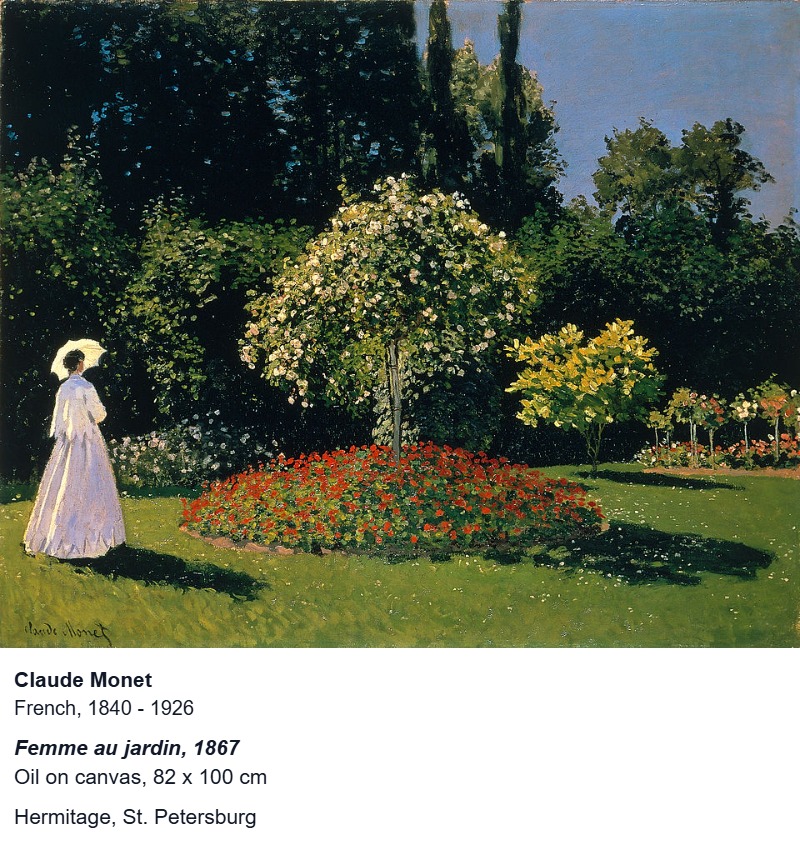
Claude Monet
Woman in the Garden, 1867
Oil on canvas

Extended
Claude Monet (French, 1840–1926)
Woman in the Garden (Femme au jardin), 1867
Oil on canvas; 82 × 100 cm
The State Hermitage Museum, St. Petersburg
An early outdoor scene that shows Monet’s interest in natural light, fashion, and garden color.
Photograph caption examples
For photographs, name the process clearly. “Photograph” alone is weak; “gelatin silver print” or “archival pigment print” tells viewers how the image was made and helps future cataloging.
Short
Dorothea Lange
Migrant Mother, 1936
Gelatin silver print

Extended
Dorothea Lange (American, 1895–1965)
Migrant Mother, Nipomo, California, 1936
Gelatin silver print; 28.3 × 21.8 cm
Museum of Modern Art, New York
One of Lange’s best-known Farm Security Administration images, documenting Depression-era hardship with direct, close framing.
Sculpture caption examples
Sculpture captions should include depth when available (height × width × depth) and the material. If the work is an edition, note that after the medium line.
Short
Alberto Giacometti
Walking Man I, 1960
Bronze

Extended
Alberto Giacometti (Swiss, 1901–1966)
Walking Man I, 1960
Bronze; 183 × 26 × 95.5 cm
Fondation Giacometti, Paris
An elongated standing figure that became one of Giacometti’s defining postwar sculptures.
More useful example variations
Not every work has a tidy artist-title-date package. These variations show honest museum-style wording when information is incomplete or nonstandard.
Unknown artist
Untitled portrait, c. 1885
Oil on panel; 24 × 18 cm
Private collection

Artist unknown
Vessel with geometric motif, undated
Terracotta; height 31 cm
Museum study collection

Studio of Rembrandt van Rijn
Portrait of a Man, mid-17th century
Oil on canvas
On loan from a private collection
How to reuse these examples
Copy the structure, not the famous names. Swap in your artist, title, year, medium, and size. Keep field order identical across a series so a wall of labels feels coherent.
Use the short form for social posts, contact sheets, and quick documentation. Use the extended form for exhibition walls, catalogs, and teaching materials.
- Keep artist → title → date → medium → dimensions → credit
- Italicize titles in print when you can
- Be specific about photographic processes and sculptural materials
- Prefer “c. 1920” or “undated” over a guessed year
Create your own caption in ArtCaption
Once you pick an example format, drop your artwork into ArtCaption, fill the same fields, and export a clean museum-style label for web or print — privately in your browser, with no upload to our servers.
FAQ
- What are good museum artwork caption examples to copy?
- Start with artist, italicized title, date, medium, dimensions, and credit line. Use short examples for web and social posts; use extended examples when you need a brief interpretive sentence.
- Do painting, photo, and sculpture captions use different formats?
- The order stays the same. What changes is the medium line: paintings name support, photographs name the process, and sculpture often includes depth and material.
- Can I use museum caption examples for my own artwork?
- Yes. Keep the structure and replace the content with your details. Do not invent missing facts — use honest placeholders when needed.
- Should every caption include a credit line?
- Credit lines matter for loans, collections, and published catalogs. For personal portfolios they are optional, but consistent formatting still helps.
Related guides
- How to Title a Painting: Clear Artwork Names for Galleries, Sales, and Online Captions
- Free Museum/Exhibition Label Generator (No Design Skills Needed)
- How to Add a Caption Under an Artwork Photo (Without Photoshop)
- How to Write a Caption for a Painting (Artist, Title, Year, Medium)
- Artwork Caption Template: Copy-Paste Museum Labels for Paintings (Free Examples)
- Artwork Captions for Collectors: Catalog Your Collection Like a Museum
- Artwork Captions for Auction Houses: Consistent Credits from Catalog to Bid Room
- Exhibition Labels for Galleries: Consistent Captions Across Shows, Social, and Press
- Artwork Captions for Emerging Artists: Look Professional Before the Gallery Does
- Why Every Artwork Photo Needs a Caption Online
- How to Write an Exhibition Wall Label
- How to Write a Museum-Style Artwork Caption
Create your caption next
Upload an artwork image and generate a clean museum-style caption in seconds — privately on your device.
Add a Caption