Guides/Article
How to Write an Exhibition Wall Label
8 min read · Updated September 11, 2026
An exhibition wall label does two jobs at once: it identifies the artwork and helps visitors understand why it is on the wall. Galleries, museums, and student shows all use the same core structure — a short “tombstone” block, then optional interpretive text.
This guide shows how to write wall labels that stay readable from a few feet away, stay consistent across a whole exhibition, and still feel specific to each work. For the basic caption fields, see How to Write a Museum-Style Artwork Caption. For ready-to-copy samples, see Museum Artwork Caption Examples (Painting, Photo, Sculpture).
Wall label vs caption: what changes on the wall
A caption under a photo online can be dense. A wall label must work for standing visitors: larger type, fewer lines in the identifying block, and interpretive text that earns its space.
Most exhibitions use two layers. The tombstone identifies the work. The wall text (when needed) adds context — theme, technique, history, or a prompt for looking.
- Tombstone: artist, title, date, medium, dimensions, credit
- Wall text: 1–4 short sentences of interpretation
- Object label: one work; section text: a group or room theme
Start with a clean tombstone
Write the identifying block first and keep the field order identical for every work in the show. Visitors scan labels quickly; consistency builds trust.
Artist Name (nationality, birth–death if useful)
Title of the Work, Year
Medium on support; dimensions
Lender or collection credit
Add interpretive text only when it helps
Not every work needs a paragraph. Use extended text when the object is hard to read visually, when the show argument depends on it, or when visitors need one clear fact they cannot see.
Keep interpretation after the tombstone, never before. Lead with what the work is, then why it matters here.
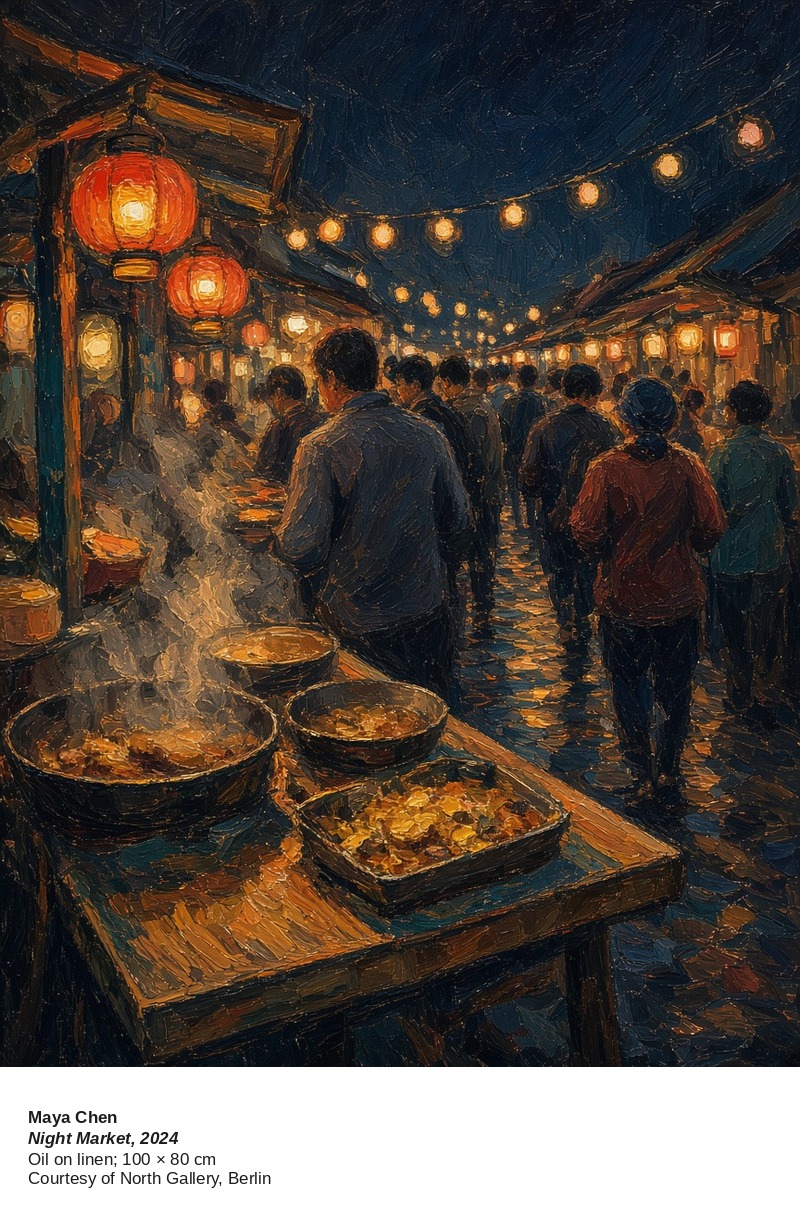
Maya Chen (American, b. 1991)
Night Market, 2024
Oil on linen; 100 × 80 cm
Courtesy of the artist

Chen paints street stalls from memory rather than photographs, letting color and crop do the work of recollection. The tilted table edge pulls you into the aisle as if you were shopping after dark.
Length, hierarchy, and readability
Aim for a tombstone of three to five lines. Interpretive text is strongest at roughly 40–80 words. If you need more, consider a section panel instead of overloading every object label.
Use one type hierarchy across the exhibition: artist name strongest, title next, then medium and credit in a quieter weight. Left alignment is usually easier to read in rows of labels.
- Same margins and column width for every label
- Same measurement system (cm or in) throughout the show
- Same credit wording style (“Courtesy of…”, “Collection of…”, “Private collection”)
- Avoid stacking multiple artworks’ stories onto one crowded panel unless it is intentional section text
Writing tips that keep visitors reading
Prefer concrete looking cues over vague praise. “Notice the scraped ground layer along the horizon” helps more than “a powerful meditation on memory.”
Write for a first-time visitor. Define terms once if needed, then move on. One idea per label beats three competing claims.
- Lead with what can be seen or verified
- Use active, plain language
- Cut throat-clearing openers (“This work explores…”)
- Match tone to the exhibition, not to academic jargon
A practical wall-label checklist
Before printing or exporting labels for install, run the full set as one list. Inconsistencies are easier to catch in batch than one label at a time.
- Every label has artist → title → date → medium → dimensions → credit in the same order
- Titles are treated consistently (italics in print when possible)
- Unknown information uses honest wording (c., undated, Untitled)
- Interpretive text is optional and sits below the tombstone
- Section texts are visually distinct from object labels
Produce exhibition labels with ArtCaption
Once your wall-label structure is set, use ArtCaption to place the tombstone under each artwork image and export clean labels for install docs, web previews, or print — privately in your browser, with no upload to our servers.
FAQ
- What should an exhibition wall label include?
- At minimum: artist, title, date, medium, dimensions, and credit line. Add a short interpretive paragraph only when it helps visitors understand the work or the exhibition theme.
- How long should exhibition wall text be?
- Keep the identifying tombstone to a few lines. Interpretive wall text is usually strongest between about 40 and 80 words. Longer narratives belong on section panels.
- What is a tombstone label?
- A tombstone is the compact identifying block on a wall label — artist, title, date, medium, size, and credit — before any interpretive writing.
- Should every artwork in a show have the same label format?
- Yes for the tombstone order and typography. Consistency makes the exhibition easier to read. Interpretive length can vary, but the identifying structure should not.
Related guides
- How to Title a Painting: Clear Artwork Names for Galleries, Sales, and Online Captions
- Free Museum/Exhibition Label Generator (No Design Skills Needed)
- How to Add a Caption Under an Artwork Photo (Without Photoshop)
- How to Write a Caption for a Painting (Artist, Title, Year, Medium)
- Artwork Caption Template: Copy-Paste Museum Labels for Paintings (Free Examples)
- Artwork Captions for Collectors: Catalog Your Collection Like a Museum
- Artwork Captions for Auction Houses: Consistent Credits from Catalog to Bid Room
- Exhibition Labels for Galleries: Consistent Captions Across Shows, Social, and Press
- Artwork Captions for Emerging Artists: Look Professional Before the Gallery Does
- Why Every Artwork Photo Needs a Caption Online
- Museum Artwork Caption Examples (Painting, Photo, Sculpture)
- How to Write a Museum-Style Artwork Caption
Create your caption next
Upload an artwork image and generate a clean museum-style caption in seconds — privately on your device.
Add a Caption