Guides/Article
Artwork Captions for Emerging Artists: Look Professional Before the Gallery Does
8 min read · Updated September 11, 2026
You do not need a gallery to look gallery-ready. Emerging artists who caption every work with the same clarity as a museum wall — artist, title, year, medium, size — signal seriousness long before a dealer arrives.
This guide is for young and early-career artists building a first portfolio, posting studio shots online, or preparing an open studio. If you want the full field order, see How to Write a Museum-Style Artwork Caption. If credit keeps disappearing in reposts, see Why Every Artwork Photo Needs a Caption Online.
Why captions matter before you are “in” a gallery
Collectors, curators, professors, and peers often meet your work as a photo first. A clean caption turns that photo into documentation. No caption turns it into content that ages poorly.
Consistent labels also help you. When titles, dates, and mediums stay stable across Instagram, your website, and PDF portfolios, you stop reinventing the facts every time you post.
What “gallery-ready” looks like in practice
You are not writing a catalogue essay. You are making the work identifiable in five seconds. Use the same short block everywhere:
Your Name
Title of the Work, Year
Medium; dimensions

Optional extras when useful
Edition 2/10
Courtesy of the artist
Available / NFS
Where emerging artists need captions most
Prioritize the places where your work travels without you in the room:
- Portfolio websites and PDF leave-behinds
- Instagram and other social posts of finished work
- Open studios, degree shows, and group exhibitions
- Applications, residencies, and grant submissions
- Press images and “shareables” for collaborators
A simple workflow that scales with your practice
Caption while the work is still fresh — right after you photograph it. Waiting until “later” is how untitled files multiply.
Keep one source of truth: a notes doc, spreadsheet, or studio inventory with title, year, medium, and size. Copy from that list into every post so spelling and dates never drift.
- Photograph → caption → publish (in that order)
- Reuse the same field order on every platform
- Prefer honest unknowns (Untitled, c. 2025) over invented facts
- Update the caption if the title or date changes — then update old posts when you can
Common early-career caption mistakes
Most of these are easy to fix once you notice them:
- Posting only the image with no identifying text
- Changing title spelling between posts
- Skipping medium (“mixed media” when you can be specific)
- Writing a long story before the basic facts
- Using different formats for every platform
Short vs extended captions for your stage
Use short captions for social grids and quick shares. Use extended captions when a school, residency, or exhibition asks for wall text or catalog entries.
Short
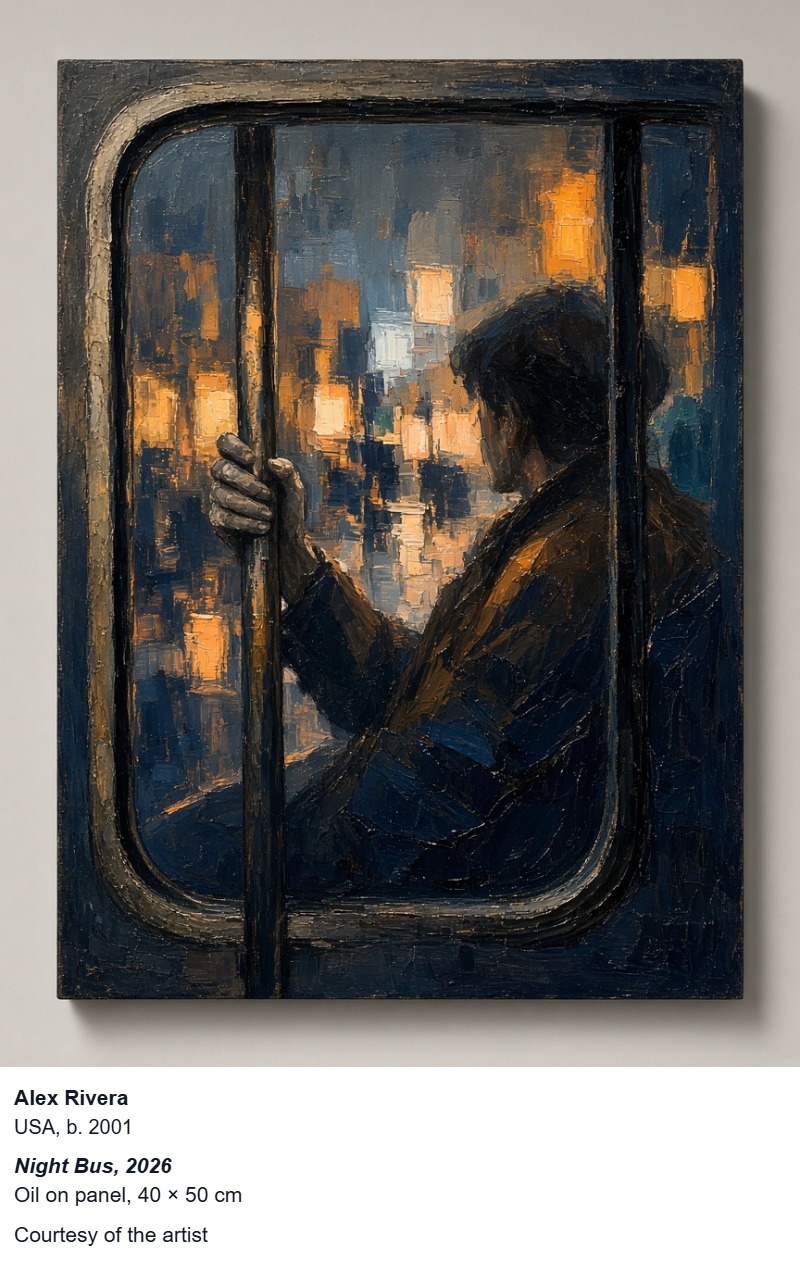
Alex Rivera
Night Bus, 2026
Oil on panel; 40 × 50 cm

Extended
Alex Rivera (b. 2001)
Night Bus, 2026
Oil on panel; 40 × 50 cm
Courtesy of the artist
Painted from memory of late routes home, the cropped window frames a city that never fully resolves.
Make gallery-ready captions fast with ArtCaption
When you want the label under the image itself — for Instagram carousels, portfolio pages, or open-studio handouts — drop the photo into ArtCaption, fill the fields once, and export a museum-style caption. Processing stays private in your browser, with no upload to our servers.
FAQ
- Do emerging artists really need museum-style captions?
- Yes if you want your work to look documented, not disposable. A short artist / title / year / medium block is enough to look professional across portfolio and social posts.
- What should I put under Instagram artwork posts?
- At minimum: your name, title, year, and medium. Add dimensions when space allows. Putting that block in the image as well as the caption field helps when people screenshot the work.
- How do I caption work if I have not titled it yet?
- Use Untitled and a year, or a working title you are ready to keep. Avoid posting with no identifying line at all — that is how works become untraceable.
- Can captions help with residencies and applications?
- Yes. Consistent captions make portfolios easier to review and reduce errors in submission forms. Reviewers notice when documentation is clear and stable.
Related guides
- How to Title a Painting: Clear Artwork Names for Galleries, Sales, and Online Captions
- Free Museum/Exhibition Label Generator (No Design Skills Needed)
- How to Add a Caption Under an Artwork Photo (Without Photoshop)
- How to Write a Caption for a Painting (Artist, Title, Year, Medium)
- Artwork Caption Template: Copy-Paste Museum Labels for Paintings (Free Examples)
- Artwork Captions for Collectors: Catalog Your Collection Like a Museum
- Artwork Captions for Auction Houses: Consistent Credits from Catalog to Bid Room
- Exhibition Labels for Galleries: Consistent Captions Across Shows, Social, and Press
- Why Every Artwork Photo Needs a Caption Online
- How to Write an Exhibition Wall Label
- Museum Artwork Caption Examples (Painting, Photo, Sculpture)
- How to Write a Museum-Style Artwork Caption
Create your caption next
Upload an artwork image and generate a clean museum-style caption in seconds — privately on your device.
Add a Caption